

I love entering the water and watching the ripples. It’s quiet. In my solace I have put me gear together, done all my safety checks, ate a small snack. Pondering. Lost in the moment. No one to help struggle into gear, run back up the shore to grab forgotten gear or weights, or listen to the grunts and groans of working into a tight wetsuit. It’s a moment for me. I am competent, confident, and specifically trained to dive alone.
The thought of diving alone is close to heresy to some divers who certified under certain agencies and horrifying to non-divers who only “know” two things about diving, “Those ‘oxygen’ tanks are big” and “Never dive alone”. For the first, those are air tanks and contain air and not oxygen, and the second I will focus on in detail.
SCUBA diving actually started as a solo sport. You could go to your local sporting goods store or hardware shop and purchase the equipment. All one had to do was find a reputable air source, often at a sporting goods shop or later in shops that specialized in SCUBA. It wasn’t until the need to train divers on the hazards of diving that sales (from a liability standpoint) of equipment was only sold by manufacturers to established shops that also provided training.
Soon training agencies started popping up with established courses for dive training. Buddy diving was part of this curriculum. Buddy diving was essential in the early days of diving when equipment had many failure points, diving knowledge in the recreational aspect was still in its infancy, and often times new divers needed a buddy to help bail them out. The buddy rule was established prior to inflation devices, advancement of the single hose- two stage regulators, submersible pressure gauges, and movement from the spring operated (J-valve) system.

Many times diving alone is the safer option. Low visibility, silt outs, and other underwater episodes have to be taken care of alone because you could get your buddy hurt in the process.
While in New Jersey, I was trained in solo diving. Every wreck dive that is done in the North Atlantic- even if you are with a dive buddy winds up being a solo dive. You drop to the end of the anchor, give the OK signal, and then due to visibility, tightness of spaces, not wanting to silt out your buddy, or because there are slightly different objectives, you are on your own. Because of that I was trained to resolve issues on my own, manage gas (air/nitrox/etc), and provide redundant systems. I have a back-up for everything on my gear including air.

Abby’s first dive. There was an instructor, four “never been in the water” divers, three semi experienced divers, and me.
With the instructor watching the students, who was my buddy?
No one. I was solo diving.
As an instructor, I dive alone even with students. I cannot realistically expect a new diver to be prepared to rescue me, in fact if I am not solo diving with students in tow, I am putting them in danger in the unlikely event something should go wrong. In fact, its not limited to students, any one that is not as a minimum certified in SCUBA Rescue I cannot count on for rescue.
When in a dive shop in 2016 preparing to go to Hawaii, I checked into a dive store to reacquaint myself with diving. I noticed that PADI offered a “Solo” certification. I talked to the owner, showed them my dive log (volumes 17-20), talked philosophy, techniques, etc and went on a dive with them. Reached into my wallet to pay the fee and I now hold a Solo Diver card. $75 for something I had done on about 95% of my dives since 1994.
I dive alone because of many reasons. The places I want to dive, when I want to dive, and the elements I dive in are not the clear and warm waters others like to dive in. I am in Idaho and finding dive buddies is almost impossible, but even before in Texas, New Jersey, Hawaii, and Saudi Arabia, having the abillity to throw gear in the truck and go was a freedom I enjoyed, often on a daily basis.
Many of the sites I am going to are not interesting to others. Most divers (and this is not ego) I would not trust to help me and when I’m in the mood to look after other divers I have a few folks that are still learning and need help, those people I love to dive with.
When I dive alone its my chance to be still and observe. I can watch a motionless catfish for 15 minutes and never realize the time that has passed. I also dive in my secret spots where I like to find treasures, so I don’t dive with others since I would be giving away my secret spots.

I treasure dive and diving solo keeps my spots a secret.
I am trained, I am confident, I am competent, and I am able to dive alone. I realize it’s not for everybody and I would not endorse it for most divers I know. There are dives I don’t do alone. New environments I am not familiar with, advanced diving techniques, and anyplace I don’t have a direct ascent to the surface all are dives I do with a buddy.

Here I provide over-watch as Abby adjusts her tank. This is something every diver has to learn to do on their own. Remove the SCUBA unit, tighten the strap, and replace. Low visibility conditions at 25 feet. A buddy can help, but with only 5 feet of visibility, two buddies could silt out the area and be in greater danger.
Solo diving is not as renegade as is used to be and many in the field are coming to terms with it. But like many urban legends such as eating then swimming will give you cramps, chocolate gives you zits, a lady dried her poodle in a microwave, and the business man who woke in an ice bath to find he had is organs stolen, the diving (and non-diving) world needs to ask themselves as to why we still believe buddy diving is the only way to dive and solo diving is so against the grain.

1995 in New Jersey. About to do a bottle dive at Little Egg Inlet. Diving alone was the norm and I was in the water nearly everyday while stationed there either on a dive boat exploring ship wrecks or in the local rivers and inlets searching for pre-1930s bottles and artifacts.
Side note– notice the affinity for old milk crates to store dive gear.
Perhaps solo diving is a reflection of me. The drive to take care of myself, stand on my own, the desire for quiet and less stress. It helps me keep my inner circle small. It provides opportunities for contemplative experiences. It’s that time I can be a dive team of one.
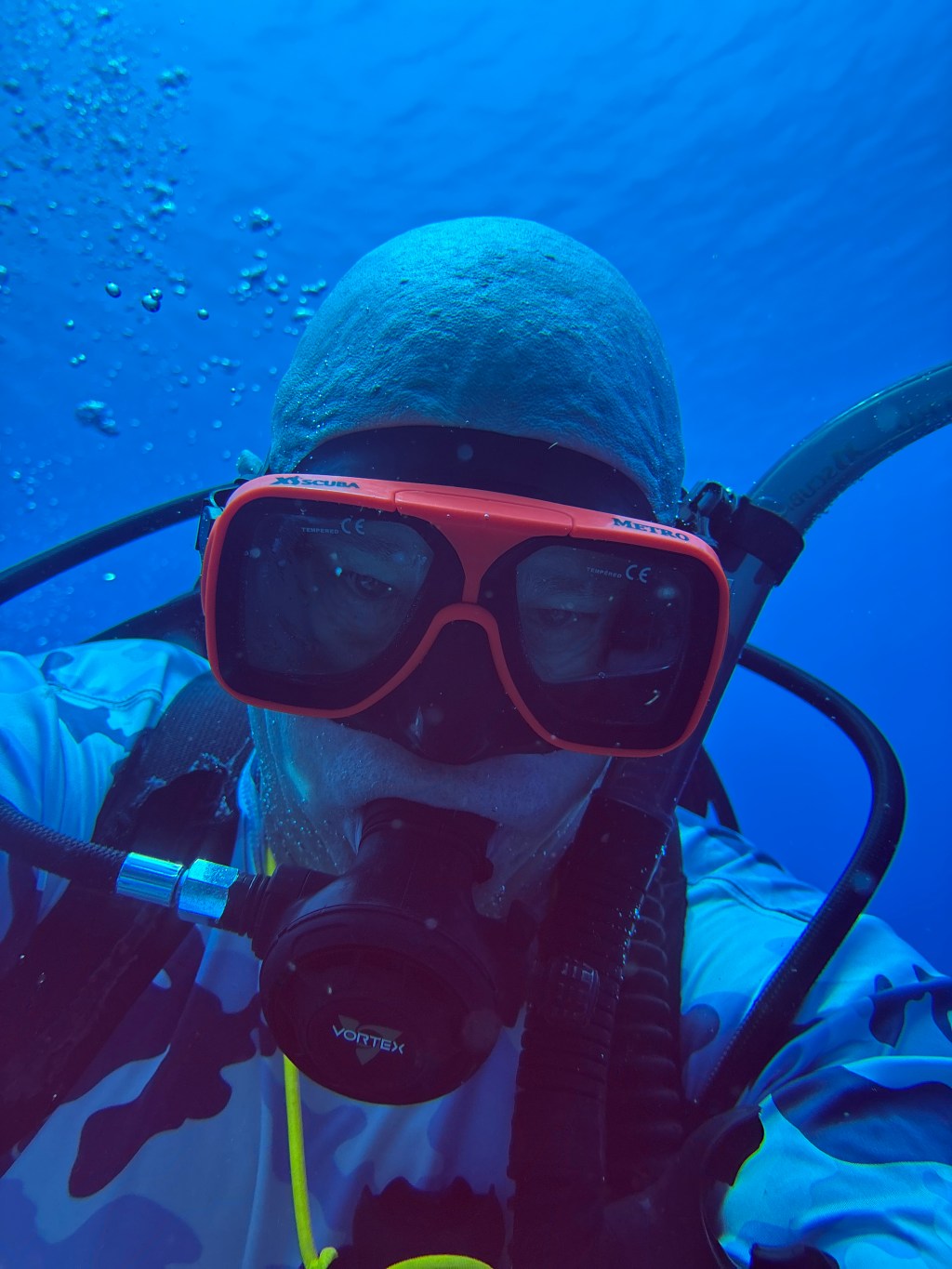

 The Neptune Warrior
Leave a comment